If you are navigating services for a family member with an intellectual or developmental disability (IDD) in Texas, you may hear the term Community First Choice, or CFC.
The name can be confusing, especially when families are already hearing terms such as HCS, TxHmL, Medicaid, LIDDA and service coordination.
So, what exactly is CFC?
Community First Choice is a Medicaid program that can provide certain services and supports to eligible people who need assistance with everyday activities and want to live in a home or community setting.
What Is Community First Choice?
CFC stands for Community First Choice.
CFC provides home and community-based attendant services and supports to eligible Medicaid recipients.
The purpose is to help eligible individuals receive the assistance they need while living in the community.
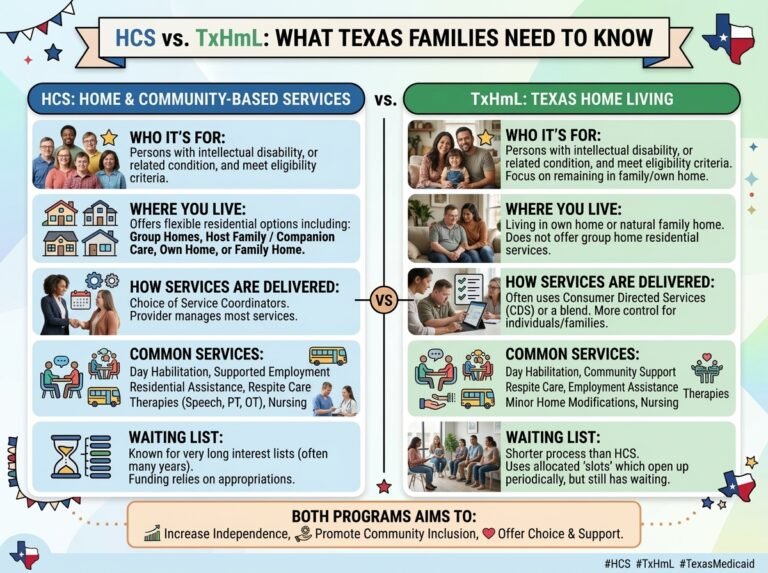
One important point for families to understand is that CFC is not the same thing as HCS or TxHmL.
HCS and TxHmL are Medicaid waiver programs. CFC services are provided through the Medicaid State Plan.
Depending on a person’s circumstances, CFC services may also be provided alongside certain waiver services.
What Services Can CFC Provide?
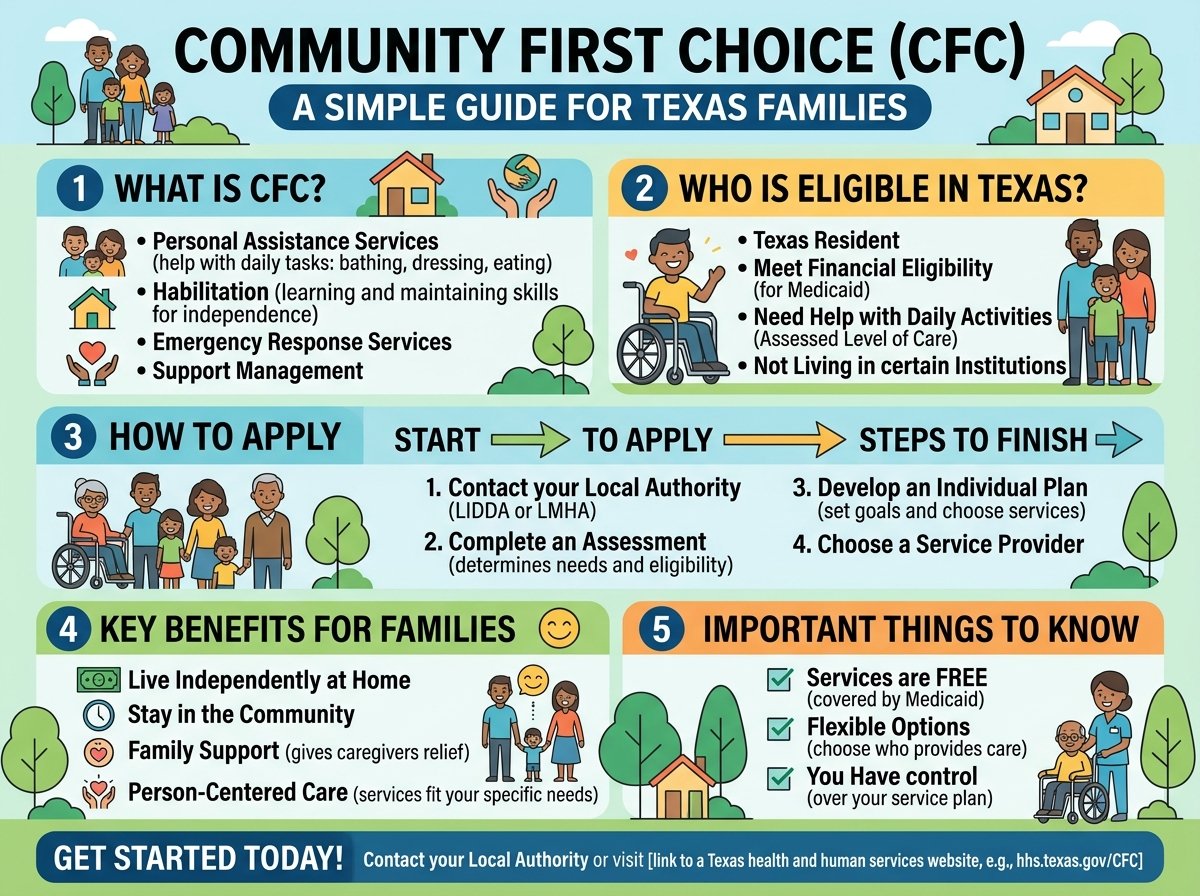
CFC includes four primary types of support:
Personal Assistance Services (PAS)
Personal Assistance Services help an individual with activities of daily living and instrumental activities of daily living.
Depending on the person’s assessed needs, this can include hands-on assistance, supervision or reminders with everyday activities.
Habilitation (HAB)
Habilitation focuses on helping a person acquire, maintain or improve skills needed to complete everyday activities.
The distinction between assistance and habilitation is important.
For example, a person may need assistance completing a household activity. Another person may need support learning or maintaining the skills needed to participate in that activity more independently.
The person’s individual needs determine the appropriate support.
Emergency Response Services (ERS)
Emergency Response Services provide eligible individuals with a backup system for obtaining assistance in an emergency.
ERS may be appropriate for someone who lives alone, spends significant periods of time alone or does not have a regular caregiver available for extended periods and otherwise requires extensive routine supervision.
Support Management
Support management is a voluntary service that can provide training to help an individual or their representative learn how to select, manage and dismiss attendants.
What Are ADLs and IADLs?
Families may hear these terms when CFC services are being discussed.
ADL means Activity of Daily Living.
These are basic activities involved in caring for yourself.
Examples can include:
- bathing
- dressing
- eating
- toileting
- personal hygiene
- moving around safely
IADL means Instrumental Activity of Daily Living.
These are activities that help a person manage everyday life and their household.
Examples may include activities such as preparing meals, performing household tasks and other activities necessary for living in the community.
The amount and type of assistance a person needs can vary greatly. One individual may need occasional reminders, while another may require extensive hands-on assistance.
Is CFC Only for People With IDD?
No.
Community First Choice is not exclusively an IDD program.
It is available to eligible Medicaid recipients who meet CFC requirements, which include meeting an institutional level-of-care requirement and having a need for CFC services.
For NUDO Homes families, however, CFC is especially important to understand because people with intellectual and developmental disabilities may receive CFC services in different ways depending on their Medicaid and waiver status.
Do You Have to Be Enrolled in HCS or TxHmL to Receive CFC?
Not necessarily.
This is an important distinction.
Some eligible Medicaid recipients can receive CFC services even though they are not currently enrolled in an IDD waiver program.
People who are enrolled in certain IDD waiver programs may also receive CFC services through their waiver provider.
This means families should not assume that CFC and HCS or TxHmL are interchangeable. They are different programs that can sometimes work together.
What Does CFC Habilitation Look Like in Everyday Life?
Habilitation is easier to understand when we think about everyday skills.
Imagine an adult with IDD who wants to participate more independently in preparing breakfast.
The person may need support learning the steps involved, organizing the items needed, safely completing the task and cleaning up afterward.
Another individual may already know the steps but need reminders or assistance with certain parts of the activity.
CFC habilitation is intended to support the acquisition, maintenance and improvement of skills needed to perform activities of daily living, instrumental activities of daily living and health-related tasks.
The goal should be based on the individual’s abilities, needs and person-centered plan.
How Are CFC Needs Determined?
CFC services are based on an assessment of the individual’s needs.
Texas HHSC’s CFC assessment process considers areas such as:
- the person’s ability to perform daily activities;
- functional limitations;
- the amount of assistance the person requires;
- health-related tasks;
- the person’s preferences;
- potential health and safety risks; and
- whether emergency response services or support management may be needed.
The assessment is developed through a person-centered planning process.
This is important because two people with the same diagnosis may have very different abilities and support needs.
Services should therefore be based on the individual rather than simply on the person’s diagnosis.
Can Individuals Have Choices in How CFC Services Are Delivered?
Depending on the program and service, individuals may have different service-delivery options.
One option families may hear about is Consumer Directed Services (CDS).
CDS allows an individual or legally authorized representative to take greater responsibility for directing certain services, including activities associated with selecting and managing service workers.
Agency-based service delivery may also be available.
Understanding these options can help individuals and families decide how much responsibility they want to have for managing services.
Why Is CFC Important for Families?
Families sometimes focus entirely on Medicaid waiver programs when they begin looking for IDD services.
CFC is another important part of the Texas Medicaid service system.
For an eligible individual, the right assistance can support everyday activities, help maintain or develop skills and make living in the community more sustainable.
The key is understanding what the individual actually needs.
Instead of beginning with, “What program can we get?”, families can also ask:
What does this person want to be able to do?
What can they currently do independently?
Where do they need assistance?
What skills could they develop or maintain with appropriate support?
Those questions help keep the individual at the center of service planning.
Helping Families Understand IDD Services
At NUDO Homes, we believe individuals with intellectual and developmental disabilities and their families should have access to clear and understandable information about available services and supports.
Our Understanding IDD Services series breaks down common Texas IDD terms and programs so families can better understand the system, ask informed questions and participate actively in planning services for their loved ones.
Continue the series: Understanding Your Individual Plan of Care (IPC): Why Your Goals and Choices Matter
Last reviewed: September 2026
This article is provided for general educational purposes. It does not determine eligibility for Medicaid, Community First Choice or any other Texas Health and Human Services program. Eligibility, assessments and authorized services are determined according to applicable Medicaid and Texas Health and Human Services requirements. Program requirements may change.