
Finding out that your child has a disability can bring a lot of questions.
What help is available?
Who do I call?
Does my child qualify for Medicaid?
What happens when my child becomes an adult?
Do I need to apply for services now?
Texas has many programs for children and adults with disabilities, but knowing where to begin can be confusing.
You do not need to understand the entire system today.
Start with one step at a time.
Step 1: Learn What Your Child Needs
A diagnosis is important, but your child’s everyday needs are important too.
Think about where your child needs help.
Does your child need help with:
- bathing, dressing or eating?
- communicating?
- learning everyday skills?
- behavior?
- staying safe?
- making friends and participating in the community?
- getting to appointments or activities?
- supervision?
- preparing for adulthood?
Write these things down.
This information can be useful when you speak with schools, doctors, Medicaid programs and disability service organizations.
Step 2: If Your Child Is Under 3, Ask About Early Childhood Intervention
Texas has a program called Early Childhood Intervention, usually called ECI.
ECI serves eligible children from birth up to age 3 who have a developmental delay, disability or certain medically diagnosed conditions.
Services are designed to support young children and their families during an important period of development.
If your child is younger than 3 and you are concerned about development, ECI is one resource worth asking about.
Step 3: Learn About Your Local IDD Authority
If your child has or may have an intellectual or developmental disability, another important name to learn is LIDDA.
LIDDA stands for Local Intellectual and Developmental Disability Authority.
Texas is divided into local service areas, and each area has a LIDDA responsible for helping people access certain publicly funded IDD services.
Your LIDDA can be an important starting point for learning about IDD services and programs in your area.
You do not have to memorize what a LIDDA does before contacting one.
You can simply say:
“My child has a developmental disability, and I am trying to understand what services may be available. Where should I start?”
That is enough to begin the conversation.
Step 4: Ask About Medicaid—Even If You Have Private Insurance
Some parents assume there is no reason to ask about Medicaid because their family already has health insurance.
That is not always true.
A person can sometimes have private health insurance and Medicaid at the same time.
Eligibility depends on the Medicaid program and the person’s circumstances.
Texas also has different Medicaid pathways and programs for children and people with disabilities.
So, do not rule your child out simply because you already have insurance.
Ask.
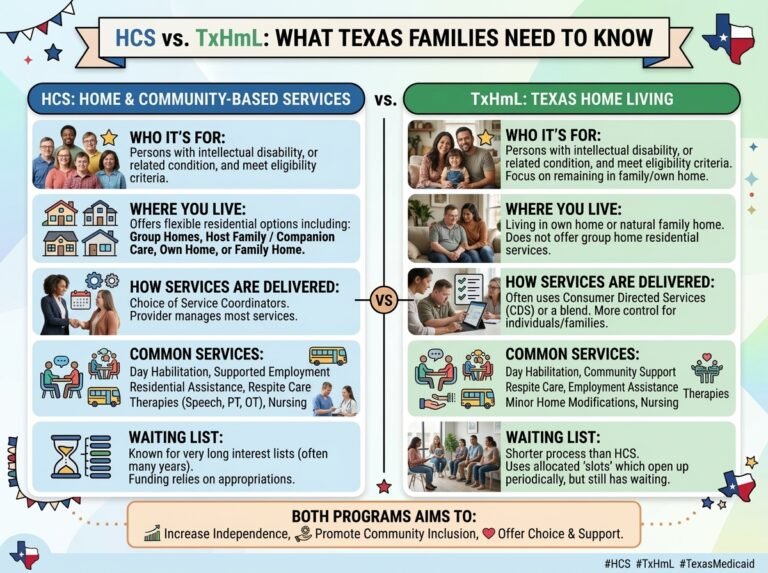
Step 5: Learn About HCS and TxHmL Early
Two names families of people with IDD may hear are:
HCS — Home and Community-based Services
and
TxHmL — Texas Home Living.
These are Medicaid waiver programs that provide certain services and supports to eligible Texans with intellectual disabilities or related conditions.
Access to waiver services can involve an interest list.
That makes it important to learn about these programs before your family is in a crisis.
Your child may be young. Your family may be managing well today. You may feel that you do not need those services right now.
Still, ask about them.
Learning about future options does not mean you have to use them today.
Step 6: Ask About Help at Home
If your child needs help with everyday activities, ask what programs may provide assistance.
Depending on eligibility and assessed needs, some programs can provide support with personal care, daily activities or developing skills.
Families may also hear terms such as:
Personal Assistance Services
Habilitation
Community First Choice
Consumer Directed Services
and
Respite
You do not need to understand all of these terms before asking for help.
Ask the person assisting you:
“Based on my child’s needs, are there programs that could provide help at home?”
Step 7: Ask About PAS and Respite
Families caring for a child or adult with IDD may not realize that help can sometimes be available in the home and community.
Personal Assistance Services (PAS) may provide eligible individuals with authorized hours of support from a provider or attendant. Depending on the person’s assessed needs and program, this support may include help with personal care, everyday activities, supervision and other approved assistance.
Respite provides temporary support when the person’s regular caregiver needs a break or needs someone else to care for the individual for a period of time.
If your child or family member needs more help, do not be afraid to ask about PAS provider hours and respite.
Ask:
“Could my child qualify for provider hours or respite services?”
The number of hours and type of support available depend on the individual’s assessed needs, eligibility, service plan and program requirements.
Looking for a Provider?
If your family has already been approved for services and you need help finding a provider, contact NUDO Homes. We can help point you in the right direction and connect you with resources that may be available in your area.
If you are unsure what services your family member has been approved for, you can still contact us. We can help you understand what questions to ask and where to start.
Step 8: Keep a Family Services Folder
You may receive a lot of information over the years.
Create one place to keep important documents.
Consider keeping:
- diagnosis and evaluation records;
- Medicaid information;
- insurance information;
- school records and Individualized Education Programs (IEPs);
- important phone numbers;
- letters from agencies;
- service plans;
- medication information;
- application dates and confirmation numbers; and
- a list of programs you have contacted.
You may not need every document today, but having information organized can make future applications and meetings much easier.
You Don’t Have to Know Everything Before You Ask
Texas disability services can involve many agencies, programs and unfamiliar terms.
Do not let that stop you from asking questions.
You can start with something as simple as:
“My child has a disability. What programs should I know about?”
Then keep asking questions.
Write down the answers.
Learn one program at a time.
And remember that your child’s needs may change as they grow.
Starting early gives your family more time to understand the choices that may be available.
Don’t Be Afraid to Ask
You may hear about a program and think:
“My child probably doesn’t qualify.”
Ask anyway.
You may hear that another family receives a service and wonder whether your child can receive it too.
Ask.
Eligibility depends on the individual and the program. Getting accurate information is better than assuming that help is unavailable.
At NUDO Homes, we believe families should have clear, understandable information about IDD services so they can ask informed questions and make decisions that fit their loved one’s needs.
Read next: Can My Child Get Medicaid If We Already Have Private Insurance?
Last reviewed: September 2026
This article provides general educational information. Eligibility for Medicaid, waiver programs and other services depends on individual circumstances and applicable program requirements. Program rules and services may change.